
Luke Skywalker
Super Moderator
{vb:raw ozzmodz_postquote}:
Punxsutawney Phil, right, is held by Ben Hughes after emerging from his burrow on Gobblers Knob in Punxsutawney, Pa., on Feb. 2, 2010.(Photo: Gene J. Puskar, AP)
It's that time again when meteorologists step aside for a furry rodent to make a weather forecast.
Punxsutawney Phil, the world's most famous groundhog, will be coaxed out of his burrow on Gobbler's Knob early Monday to let an anxious nation know whether we'll have an early spring or six more weeks of miserable cold and snow.
According to folklore, if it's cloudy when the groundhog emerges Feb. 2, the critter will leave his burrow, meaning winter will soon end. If it's a sunny day, Phil will see his shadow and, frightened, retreat back into his burrow, meaning winter will continue for six more weeks.
The forecast for Monday morning in Punxsutawney, Pa., calls for cloudy skies and a chance of snow showers, but Phil is fickle, so who knows what he'll do?
No matter the outcome, it's best not to bet heavily on Phil: His forecast is no better than flipping a coin. Based on an analysis of weather data over the past 27 years, "there is no predictive skill for the groundhog," according to the National Climatic Data Center in Asheville, N.C.
The center found that since 1988, the groundhog has been right 12 times and wrong 15 times in matching his prediction with the national average temperature for the remainder of February.
USA TODAY
Groundhog Day mishap shadows NYC
Phil has been right the past couple of winters: Last year, the groundhog predicted six more weeks of winter when he saw his shadow, and both February and March temperatures were below average across the country. In 2013, Phil didn't see his shadow, and the month ended slightly warmer than average.
Since 1887, the groundhog has seen his shadow 101 times for a longer winter and not seen it 17 times to predict an early spring. (There is no record of the prediction for nine times in the late 19th century.)
Regardless of what Phil says, "climate records and statistics tell us that winter probably isn't over," the NCDC said on its website. "Climatologically speaking, the three coldest months of the year are December, January and February, so winter typically still has a bit to go when the groundhog comes out in search of his shadow on February 2."
Although Phil is the most famous groundhog (aka woodchuck) of them all, other prognosticating critters include West Virginia's French Creek Freddie, Georgia's Gen. Beauregard Lee, Ohio's Buckeye Chuck, North Carolina's Sir Wally Wally, Alabama's Smith Lake Jake and New York's Staten Island Chuck (full name: Charles G. Hogg).
Groundhog Day has its origins in an ancient celebration of Candlemas, the midway point between the winter solstice and the spring equinox, according to the climate center.
Superstition has it that fair weather was seen as a prediction of a stormy and cold second half to winter, as noted in this Old English saying:
"If Candlemas be fair and bright,
Winter has another flight.
If Candlemas brings clouds and rain,
Winter will not come again."
Punxsutawney held its first Groundhog Day in the 1800s. The first official trek by the Punxsutawney Groundhog Club to Gobbler's Knob was made Feb. 2, 1887. One club member was an editor of the local newspaper, who proclaimed Punxsutawney Phil to be the one-and-only weather prognosticating groundhog. The tradition took off from there.
Guys in top hats and a groundhog in 1984. Must be Groundhog Day.<span style="color: Red;">*</span>(Photo: The Groundhog Club)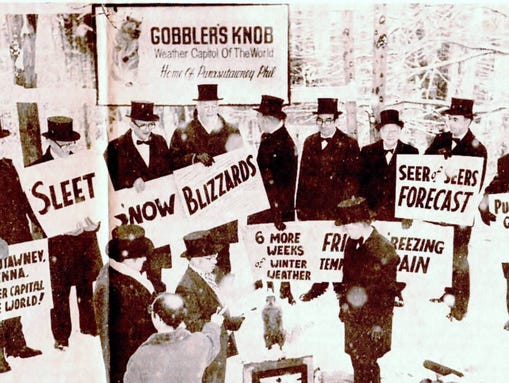
Powered By WizardRSS.com | Full Text RSS Feed